Innovative teaching and excellent lecturers who can engage students and link theoretical learning to engineering practice are a cornerstone of DTU’s strategic efforts to educate Europe’s most competent engineers.
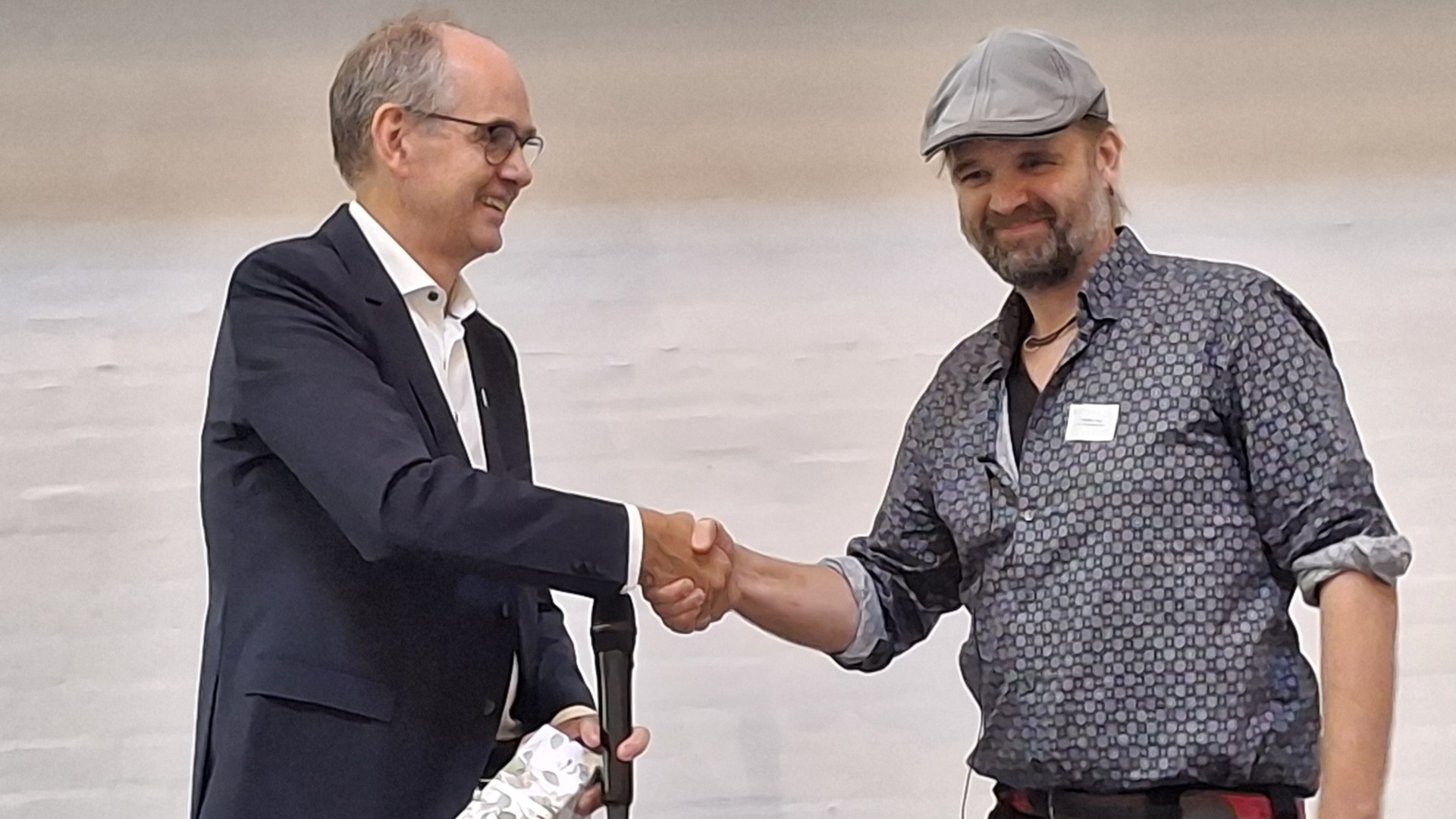
Associate Professor Bastian Epp from DTU Health Technology is one such teacher, and today he is receiving DTU’s Teaching Development Award 2026 for his work in developing the course ‘Signals and Linear Systems in Discrete Time’. Since 2012, he has been teaching and continuously developing the course, drawing on inspiration, discussions and feedback from talented colleagues across DTU.
“I am fundamentally a collectivist, and I believe that we create the best things when we work together. Across DTU, there are several colleagues and passionate individuals who, like me, are deeply committed to teaching and learning and to exploring how to create a culture of motivation rather than a culture of performance,” he explains.
With this approach to development, Epp has found a solution to a key teaching challenge in large, technically demanding courses: ensuring meaningful support, relevant feedback, a sense of safety, and active engagement among a large number of students with varying academic backgrounds.
Flipped Classroom, e-learning and small-group discussions
The course ‘Signals and Linear Systems in Discrete Time’ is a fundamental engineering course that introduces students to the key concepts and methods of digital signal processing. The course attracts many students with varying levels of prior knowledge in subjects such as mathematics and programming. This places particular demands on the design of the teaching:
“The traditional lecture format limits the opportunities for individual feedback and for building a connection with each student. Many students are reluctant to ask questions in large lectures, but on this course, we are dealing with complex mathematical problems where misunderstandings naturally arise,” explains Bastian Epp, continuing:
“That is why, as part of the course, I have introduced weekly academic discussions in smaller groups, where students have the opportunity to ask questions, discuss the material and identify any misunderstandings as the course progresses.”
Bastian Epp has continually redesigned the course to meet the need for an in-depth understanding of the material, to encourage active participation in lessons, and to facilitate discussions and critical thinking in a safe learning environment.
Among other things, he has introduced the ‘flipped classroom’, a teaching method in which students learn the basic material at home, typically through videos, texts or online resources, whilst class time is spent on identifying connections, engaging in discussions, problem-solving and applying the material, with the lecturer acting as a facilitator. It was therefore part of the new design to develop a digital learning environment in which students can access a variety of materials and communication channels.
“On the e-learning platform, I have broken the lecture down into small sections. After each section, I ask the students to reflect on 5–6 questions. And when we meet for the class, we go through it again. There is also the opportunity to meet in smaller groups and discuss the material after the class, based on each student’s understanding and reasoning,” he explains.
A supportive learning environment and a focus on active learning
The repetition and structure of the teaching across several levels create a learning environment in which students feel confident approaching the subject matter critically, and Epp’s interaction with students ensures that everyone understands the material and that misunderstandings are nipped in the bud.
“I usually tell the students that they should see me as their friendly colleague who facilitates our joint search for the most plausible solution to a mathematical problem,” says Bastian Epp, continuing:
“We focus on the exploration rather than the correct answer. That’s why I always ask students to explain why their suggestion is plausible, and then we discuss it. That’s how you learn the most, and it creates a space where everyone is part of the process.”
Students are co-creators of their learning
This approach builds trust and a sense of psychological safety and encourages students to be active co-creators of their own learning. They also respond with extremely positive course evaluations, in which they highlight Bastian Epps’ close dialogue with the students, noting that the teaching encourages them to think for themselves and gives them a sense of being seen, heard and involved in the teaching.
This is also one of the reasons why Bastian Epp receives DTU’s Teaching Development Award, explains Lars D. Christoffersen, Dean of Studies and Student Affairs:
“Bastian Epp has succeeded in creating a learning environment that gives students the desire and confidence to participate actively and take ownership of their own learning. This is clearly beneficial for the students. And it is also beneficial for DTU, which, as one of Europe’s leading technical universities, is tasked with educating the talented engineers who will benefit society in the future with new technologies and innovative ideas”.
The Dean concludes:
“Bastian’s efforts and commitment to teaching, as well as to mentoring and exchanging ideas and methods with his colleagues, are an inspiring example. It is therefore a great joy and pleasure to present him this award.”